
Your system was handed a string. Now it has to guess.
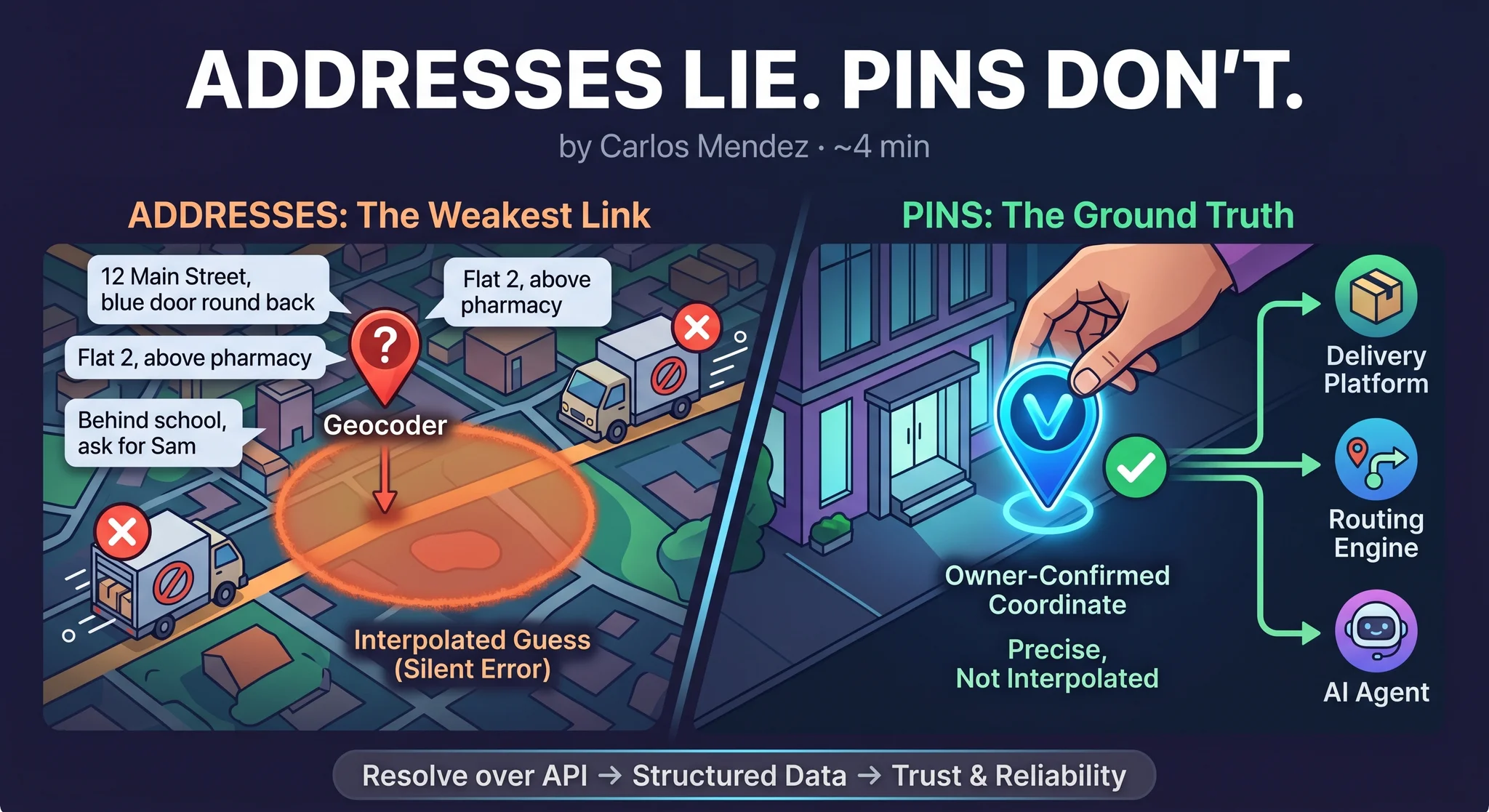
Every delivery API, routing engine, and AI booking agent eventually hits the same wall: it is handed an address as a line of text. "12 Main Street, the blue door round the back." "Flat 2, above the pharmacy." "Behind the school, ask for Sam." A local could find it in a heartbeat. A geocoder returns a coordinate that is confidently, silently wrong — and nothing downstream knows it guessed.
That guess is expensive. It is the dropped parcel, the driver circling the block, the agent that books a pickup at the wrong gate. The address looked fine. It parsed. It just didn't point anywhere real.
The address is the weakest link in the chain
Freeform addresses are the least reliable input most logistics and location systems consume, for reasons that have nothing to do with your code:
They're unstructured and locale-dependent — every country, and often every city, formats them differently.
A huge share of the world's addresses are informal, partial, or simply don't exist in any database.
Geocoders interpolate. When they don't know, they don't say so — they return a plausible point with no confidence signal you can act on.
The one person who knows exactly where the door is — the recipient — is never in the loop.
So you get a number that looks like an answer and behaves like a guess. For a delivery company that's a redelivery. For an AI agent it's worse: it acts on the coordinate with full confidence, because the string parsed and the geocoder returned a point.
A pin is a different kind of address
A VayaPin isn't a string to be parsed. It's a precise coordinate, confirmed by the person who is actually standing there, with a stable identifier you resolve over an API. Three differences matter:
Precise, not interpolated. It's the exact point a person dropped on a map — not the midpoint of a street segment.
Owner-confirmed, not inferred. A real human asserted "this is my spot." That's a trust layer geocoding fundamentally can't offer.
Resolvable, not parseable. You look it up by id and get structured data back — every time, identically.
Geocoding infers location from text. A VayaPin asserts location from ground truth. That inversion is the whole point.
How the trust gets created
That confirmation has to come from somewhere, and that somewhere is a deliberately small signup flow built for exactly this moment. A brand sends its customer a link. The customer lands on a page that opens in under a second — because it's a purpose-built page, not a heavy app — drops the exact point on a map rendered with the brand's own Google Maps key, and signs in.
Behind that tap, the confirmation reserves the spot for a short window while the rest of the flow completes, then writes a real, owned pin. The human is the sensor here: the one party who knows, without ambiguity, where "here" actually is. They do it once. Everything downstream inherits it.
The page is mobile-first and intentionally lightweight on purpose. The whole reason verification works in the field — a courier's phone, a customer on hotel wifi — is that it loads and finishes where heavier flows stall.
What your system plugs into
For the teams who actually consume this — delivery platforms, routing engines, AI agents — the integration surface is the part that matters. A confirmed VayaPin gives you:
A resolve call. Hand it the pin reference, get back the verified coordinate and brand context — no string parsing, no geocoder round-trip, no confidence guessing.
An event when a pin becomes real. A pin-created webhook fires the moment a customer completes, so your system reacts in real time instead of polling.
Your own map quota and branding. The location is confirmed on the brand's key — the same bring-your-own-key model VayaPin uses throughout — so the experience stays yours end to end.
For an AI agent, this is the difference between NLP-parsing an address and resolving an identifier. For a delivery company, it's the difference between geocoding every order and routing to a point a human already verified — once, permanently.
Built to be resolved, not parsed
The shift is small to describe and large in consequence. Stop treating location as text to be interpreted on every request. Treat it as an identifier — verified once by the person who actually knows, and resolvable forever by the machines that don't.
Addresses lie — not maliciously, just structurally. A pin, confirmed by the one person who can't be wrong about where they are, doesn't. If your system moves things, routes things, or books things in the physical world, that's the input you actually want.